
2:17 PM

Richard
, Posted in
education
,
phishing
,
0 Comments
As I mentioned in a previous blog post I'm doing a bit of lecturing for an undergraduate degree in Network Security, this semester I'm teaching Enterprise Security. This week we covered Security Engineering and were discussing, among other things, the psychology/ behavioural economics of Phishing. Rather than try and explain the incentives and mentality at play when someone clicks on a phishing link I thought I'd take a more practical approach and carry out a small simulated phishing campaign.
Using the Simple Phishing Toolkit, an excellent but sadly abandoned open source tool for running educational Phishing campaigns, I set out to phish the students under the guise that their Moodle platform had been upgraded with a number of bug and security fixes and a link to click to see a full list of the changes. The tool provides the capability to have a dummy login form, even providing an inbuilt scraper to automate the building of the form, I stopped short of this however, mainly due to time constraints. For the purposes of this exercise just clicking on the phishing link was enough to get you marked as a victim. After all, these are students who are studying security and should know better than to click on a links in an email without validating the destination and visiting a malicious site is often enough.
Having set up the campaign and pushed out the emails I went off to do some other jobs that needed doing, I didn't really expect to get too many hits on the link, it pointed at a dynamic IP and I didn't really think they would find a list of updates to Moodle worth clicking through for ( a theory that was subsequently confirmed when I spoke to them in the lecture). As it turns out either I'm a better phisherman than I give myself credit for or this group of students is a gullible bunch, 12 out of a total 32 students clicked on the link (see chart below). Given that a couple of those 32 students seem to have given up checking course related emails, the percentage may be even higher. Those that clicked on the link were redirected to a phishing education page (also supplied in SPT) with a video on phishing from Symantec.
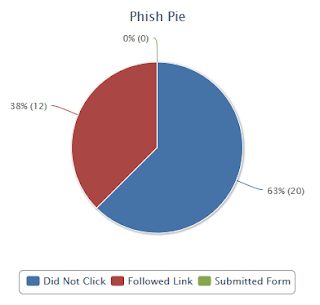
Phishing the students was certainly an interesting exercise and one that I'd like to repeat with other groups and extend into other organisations, more and more, having recognised the human element as the weak link in their security posture, organisations are running social engineering pen-tests and including simulated phishing campaigns. Done right, this could be an excellent education tool, and one worth pursuing, it serves as a nice demonstration of the types of methods used by real attackers against organisations, giving your users real experience that they can relate to net time they encounter a real phishing (or spear-phishing) email, with the right instruction and correct incentives, users can be taught to identify phishing emails and report them to your security team. The confidence to report a phishing email is even more important if the user did click on the link or fill in the form, it is important not to castigate users for making security mistakes, the knowledge that they have done so at least allows you to respond to the potential outcomes rather than having to detect it through other means. It also serves as another source of insight into the security posture of your organisation and potentially an intelligence source for identifying high risk users to be correlated against mail gateway logs.
6:30 PM
Justin
, Posted in
BYOD
,
japan
,
security
,
0 Comments
It's been quiet around here lately as I've been travelling and extremely busy with work. However it's time to get back to blogging on a semi-regular basis (I don't know what Richard's excuse is!)
While checking out the new IOS7 features recently (although I've yet to upgrade) I came across this gem:
Apps can now be configured to automatically connect to VPN when they are launched. Per app VPN gives IT granular control over corporate network access. It ensures that data transmitted by managed apps travels through VPN — and that other data, like an employee's personal web browsing activity, does not.
Now that's a nice feature (and about time), especially in the BYOD era. Speaking of BYOD, I recently had a chance to meet a number of Security managers from around the world and BYOD was a hot topic. However here in Japan it is not even on the radar for many organizations. A Logicalis
research paper [pdf] from last year showed Japan as significantly trailing other markets in regards to corporate IT actively promoting BYOD and, perhaps unsurprisingly, leading the pack in the measure of 'IT don't know about it but we're doing it anyway'.
Why is Japan slow to embrace this trend? My personal view is it is a combination of inherently conservative companies and IT departments (who are unwilling to give up control) combined with the strict labour laws regarding overtime work. As we've seen in the west, mobility and BYOD blur the lines of work/life significantly and risk putting companies here on the wrong side of the law if employees are found to be working excessive overtime.
As we move into the age of the Internet of Things, expect to see more and more stories like this one, where a luxury toilet firm here in Japan have developed a Android-app controlled 'smart toilet'. The problem? All the toilets are hardcoded to a PIN of 0000 -- allowing anyone with the app (in bluetooth range) to control the toilet.
While the actual benefits of a Android-app controlled toilet escape me at present (and the impact of an attack is admittedly pretty minor), the poor security in the execution is unfortunately all too common. Today it's a toilet, tomorrow implanted medical devices (actually that is also today...).
The toilet pales in comparison to the Smart TV Hacking [pdf] research from Korea. Which is extra creepy if you're watching your smart TVon your smart toilet...
12:28 PM
Justin
, Posted in
hacking
,
security
,
weird
,
0 Comments
Remember when getting hacked was a bad thing? Now apparently it is a marketing opportunity!
US Food chain Chipolte faking it's twitter account being hacked to generate 'buzz' as a marketing exercise.
Of course while others have claimed twitter accounts were hacked to cover up embarrassing behavior, this is the first time I've seen someone making a claim of being hacked as marketing.....
After a few recent high-profile data breaches, and all the global cyberwar press, here in Japan a Cyber Defence Unit (CDU) is being created, but not without what appears to be warranted criticism.
No word on whether it will also include animal handlers for their incident investigation team.
I think I speak for us all when I say we expected any Japanese military (or SDF) related unit with the word "cyber" in it's name to include more of this kind of thing...!
1:40 PM
Justin
, Posted in
data breach
,
hacking
,
0 Comments
It's a few months old, but there's an interesting article at that home of Internet satire, The Onion on how they were hacked.
It's always good to see when companies are able to disclose some of these details so the rest of us can learn from their misfortune.
6:24 PM
Justin
, Posted in
malware
,
security
,
0 Comments
Irony: Emails about Governments snooping on private data used to distribute malware that allows criminals snoop on your private data...


